

 Falls are one of the greatest risks facing seniors, often signaling the start of a continued decline. Because just a single fall incident can result in serious medical complications or even death, leaders in health tech made fall prevention a top priority in 2021 and continue to emphasize it as resident acuity rises.
integration, Dele Health Tech has prioritized
accessibility for its partners. The need for fall
prevention technology is shared across the
entire care continuum, and it is being met by
affordable entry points made possible through
data fusion.
factors as they relate to other risks and falls in general.
The more information available, the more confidence caregivers can have in understanding specific risk factors as they relate to other risks and falls in general.
 motion sensors are logging that a resident is regularly falling in her room at night, or in the bathroom, or both, then the system labels those falls as part of a pattern.
The system’s machine learning then uses this labeled data to assign significance and meaning to data points in the data fusion process, allowing caregivers to make more accurate fall, which in turn allows them to proactively change the resident’s environment or schedule to prevent future falls.
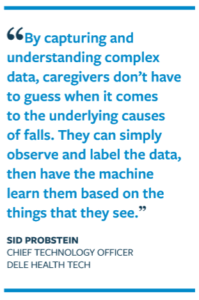
“By capturing and understanding complex data, caregivers don’t have to guess when it comes to the underlying causes of falls,” Probstein says. “They can simply observe and label the data, then have the machine learn them based on the things that they see.”
Use of data fusion from non-wearables as well as wearables and ambient sensors, user interface design, assessment of external fall risk factors and comparisons to clinical fall risk assessments help identify the risk for falling and ultimately the prevention of falling.
“Falling is a multi-factorial, multi-dimensional problem that requires a multi-disciplinary approach,” says Dele Health Tech VP of Gerontology Dr. Lydia Manning. Dele Health Tech looks for any dignified, appropriate data they can find to provide more context around potential incidents.
Research shows that when someone is on the floor for an extended period of time, several medical complications arise which can ultimately lead to death. In addition to fall prevention and the post-fall process, caregivers use real-time data capture from multiple
sources to track events as they occur, thus minimizing a resident’s time on the floor and getting them into recovery faster.
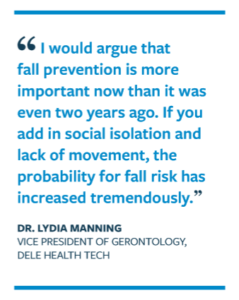
“I would argue that fall prevention is more important now than it was even two years ago,” Dr. Manning says. “If you add in social isolation and lack of movement, the probability for fall risk has increased tremendously.”
Whether the result of unprecedented staff shortages or the growing acute needs of senior living residents, the risks of and outcomes from falls are much greater now than they were prior to the pandemic. Fall detection and prevention systems are critical to mitigating those pain points, with data fusion as the key to their success.